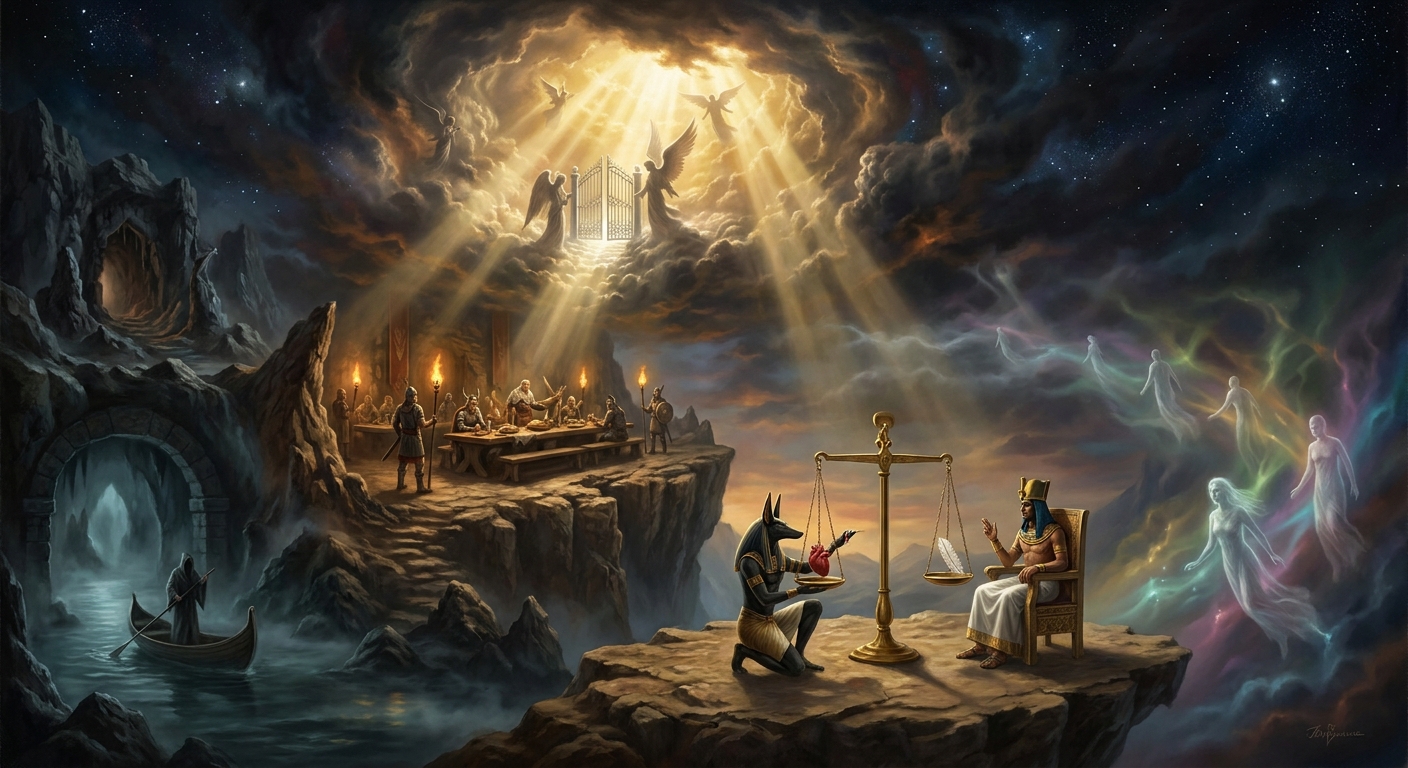
The katabasis — Greek for "going down" — is the journey to the land of the dead. It is one of the oldest narrative shapes in human storytelling, found in the *Epic of Gilgamesh* (which already has multiple underworld journeys), in the Sumerian Inanna's Descent (older still), in Homer, in Virgil, in the *Kojiki*, in the Christian Apostles' Creed ("he descended into hell"). The hero crosses a threshold the dead cannot recross. He meets the gatekeeper, gives the password, sees the geography, and either escapes by trick, by power, or by the grace of the queen of the underworld — or does not escape at all.
The descent has two ritual functions. As initiation, it kills and remakes the hero: who comes back is not who went down. As epistemology, it gives access to knowledge the living cannot reach — the dead know things, and the underworld is the library where their knowledge is kept. Inanna goes down because her sister rules there. Orpheus goes down for love. Odysseus goes down for navigation. Aeneas goes down for prophecy and political legitimacy. Heracles goes down to steal the dog. Izanagi goes down for his wife. Christ goes down (in the Harrowing of Hell tradition) to rescue the patriarchs.
The descent and the return are separable. Inanna comes back but is replaced (Dumuzi takes her place). Orpheus comes back but loses Eurydice. Izanagi comes back but breaks taboo. Persephone returns but only half the year. Christ rises, in Christian doctrine, with the spoils of hell. The descent is the same; the return is where each tradition writes its own ending.
Comparison Across Traditions 9
| Tradition | Entity | Key Trait | Story / Scene |
|---|---|---|---|
| Mesopotamian | Inanna | Queen of heaven who descends to her sister Ereshkigal's realm | Inanna passes seven gates and removes seven garments; she dies and hangs as a corpse on a hook for three days Read story → |
| Greek | Persephone | Daughter of Demeter; abducted by Hades; queen of the underworld | Hades takes her in a chariot through a chasm in the earth; the pomegranate seeds bind her below Read story → |
| Greek | Orpheus | Thracian musician whose song stops the wheels of Hades | Orpheus charms Hades and Persephone with his lyre and is granted Eurydice — but loses her by looking back Read story → |
| Japanese | Izanagi | Father-god who descends to Yomi to retrieve his wife Izanami | Izanagi finds Izanami rotting in the dark; he flees, blocking the pass with a great stone Read story → |
| Greek | Heracles | Hero of the Twelve Labors; the last labor is to bring back Cerberus | Heracles wrestles Cerberus, the three-headed dog of Hades, and drags him to the world above Read story → |
| Christian | Jesus | In the Harrowing of Hell tradition, descends to rescue the righteous dead | Between Good Friday and Easter Sunday, Christ shatters the gates of hell and leads Adam and the patriarchs out Read story → |
| Roman | Aeneas | Trojan refugee, founder of Rome; descends to consult his father's shade | With the Sibyl as guide and the Golden Bough as passport, Aeneas crosses the Styx to meet Anchises Read story → |
| Greek | Odysseus | Hero of the *Odyssey*; visits the borderland of the dead for the prophecy of Tiresias | Odysseus pours blood into a trench at the edge of Hades; the shades crowd to drink and speak |
| Finnish | Lemminkäinen | Reckless hero of the *Kalevala*; killed in Tuonela and reassembled by his mother | Lemminkäinen falls hunting the swan of Tuonela; his mother rakes him from the river and sings him back Read story → |
What the Pattern Means
The katabasis is one of the few mythic structures that scholars from very different schools agree about. Walter Burkert (*Greek Religion*, 1985) treated it as a ritual remnant of initiation — what was once enacted in mystery cults survives narratively in epic. Dionysiac, Eleusinian, and Orphic mysteries all involved symbolic descent and return; the Homeric and Virgilian texts read like the literary tail of a much older liturgical practice.
Mircea Eliade (*Shamanism: Archaic Techniques of Ecstasy*, 1951) connected the descent to the universal shaman's ecstatic journey — the soul travels to the upper or lower world to retrieve a lost soul, gather knowledge, or negotiate with the dead. The shaman is the original katabatic hero, and the literary descents preserve a memory of that. Whether the hero is Inanna or Orpheus, the structure is the same: cross the threshold, negotiate with the gatekeeper, retrieve the prize, return — or fail to return.
The Inanna text is striking partly because it predates the Greek versions by more than a millennium. *The Descent of Inanna* (Sumerian, c. 2100 BCE) has all the elements that will recur: seven gates, ritual stripping, death and corpse, mourning above, intercession by a wise god (Enki), revival, and a substitute who must take her place. Samuel Noah Kramer translated it into English in *Sumerian Mythology* (1944), and after that the comparative material exploded — every later Mediterranean descent text reads differently in Inanna's light.
Smith's caution applies here as it did for the dying-rising-god pattern: not every descent is the same. Some heroes go down and come back unchanged (Heracles, fundamentally — he just steals the dog). Some go down and come back transformed (Aeneas — he comes back with imperial destiny). Some go down to retrieve someone and fail (Orpheus, Izanagi). Some go down and replace the queen of the dead (Persephone — *she* becomes the gatekeeper). The descent is a flexible structure, not a single myth.
Christian theology has its own descent: the *descensus ad inferos*, the harrowing of hell. The Apostles' Creed declares it; the Gospel of Nicodemus (4th century) narrates it; medieval drama staged it (the "Harrowing of Hell" is one of the great mystery-play sequences). Jesus, in the interval between crucifixion and resurrection, breaks the gates of hell and leads the righteous patriarchs out. Whether one reads this as cult-borrowing from Mediterranean precedent or as a distinct theological narrative depends, again, on the priors one brings.
Notable exceptions: Buddhist cosmology has no katabasis in the heroic sense — the bodhisattva descends to hellish realms (Kshitigarbha vows to empty hell), but the structure is compassionate intercession, not heroic retrieval. The Australian Aboriginal Dreamtime ancestors enter and leave the earth fluidly, without the threshold-and-gatekeeper drama the Eurasian tradition fixates on. The descent is widespread, not universal — and where it appears, its meaning is shaped by what each tradition fears about the dead.
- Walter Burkert, *Greek Religion* (1977/1985) — descent as ritual remnant
- Mircea Eliade, *Shamanism: Archaic Techniques of Ecstasy* (1951) — the shamanic journey
- Samuel Noah Kramer, *Sumerian Mythology* (1944) — the *Descent of Inanna*
- Joseph Campbell, *The Hero with a Thousand Faces* (1949) — the monomyth's "belly of the whale"
- Bart Ehrman, *Heaven and Hell: A History of the Afterlife* (2020) — the Christian descent in context