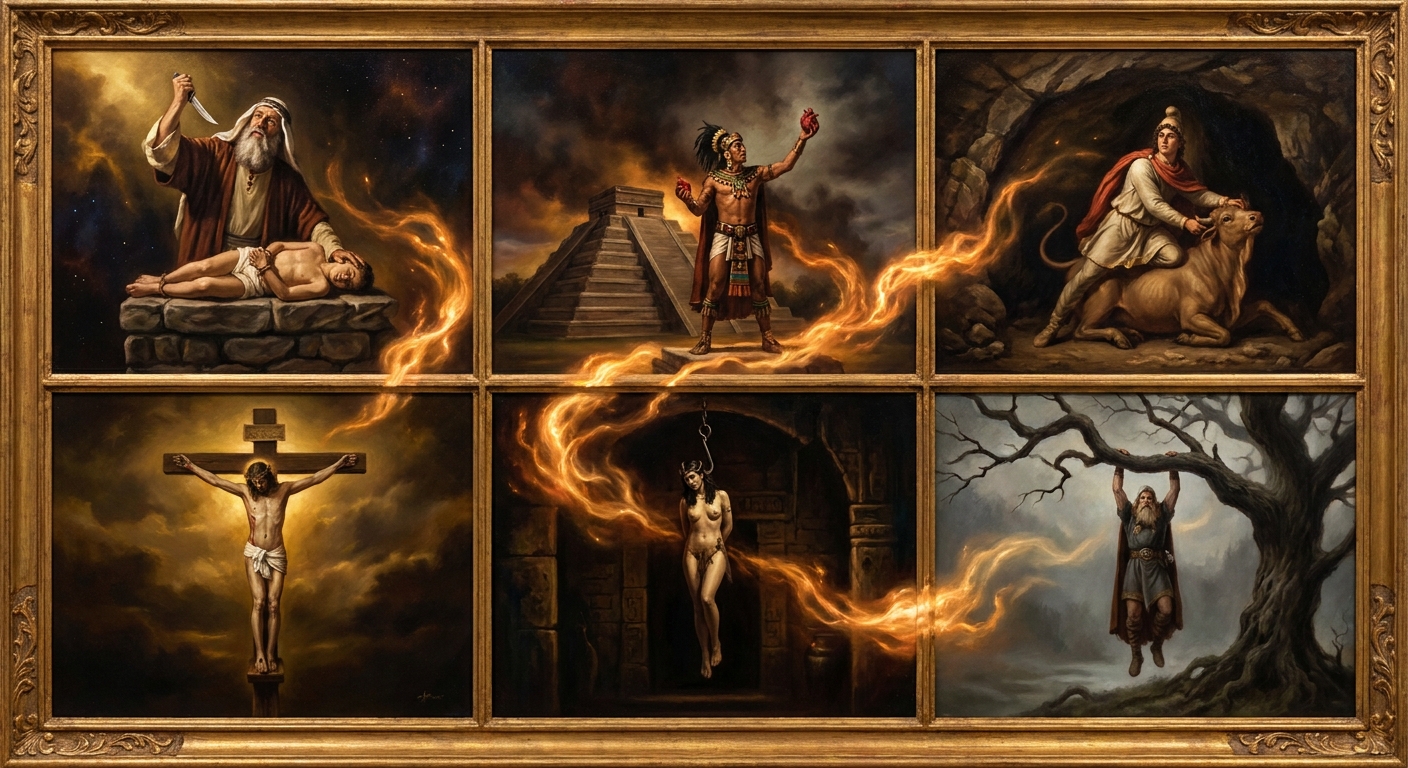
Self-sacrifice is the most extreme form of the dying-god pattern. Where most dying-and-rising gods are killed by enemies (Osiris by Set, Baal by Mot, Dumuzi by demons), some traditions develop the deeper figure of the god who chooses to die — who actively offers himself, often hung on a tree or pinned by violence at the cosmic axis. The god's death, in this version, is not a tragedy but a creative act. From his body the world is made, or remade, or saved.
The pattern is most fully developed in Christianity, where Christ's self-offering is the theological center: "Greater love has no man than this, that a man lay down his life for his friends" (John 15:13). But the structural shape is older. Odin hangs himself on Yggdrasil for nine nights, "myself to myself," and wins the runes. Quetzalcoatl burns himself on a pyre and rises as the morning star. Prometheus is bound to the rock for stealing fire on humanity's behalf. The Vedic *Purusha Sukta* (Rig Veda 10.90) tells of cosmic Purusha being dismembered by the gods, and from his body the world is made — varnas from his mouth, arms, thighs, feet; sun from his eye; moon from his mind. Mithras, in the Roman mystery cult, slays the cosmic bull, and the act of slaying *is* the cosmogony.
The pattern collects both true self-sacrifices (Christ, Odin, Quetzalcoatl) and figures whose suffering is cosmogonic but not exactly chosen (Purusha, the bull-as-cosmic-victim in Mithraism). It also overlaps significantly with the dying-and-rising-god pattern (see that page) but adds the volitional element: not just death and return, but death freely undertaken for a creative or redemptive purpose.
Comparison Across Traditions 6
| Tradition | Entity | Key Trait | Story / Scene |
|---|---|---|---|
| Christian | Jesus | Voluntary self-offering on the cross; "no one takes my life from me, I lay it down" (John 10:18) | Crucified under Pontius Pilate; on the third day rises; the offering is, in Christian theology, salvific for all humanity Read story → |
| Norse | Odin | Hangs himself on Yggdrasil for nine nights, pierced with a spear, "myself to myself" | In the *Hávamál*, Odin hangs without food or drink until the runes rise from below — knowledge bought by self-sacrifice Read story → |
| Aztec | Quetzalcoatl | Burns himself on a pyre after his fall; rises as the morning star (Venus) | Defeated and shamed by Tezcatlipoca, Quetzalcoatl exiles himself east; on the shore he immolates himself; his heart becomes the morning star Read story → |
| Greek | Prometheus | Steals fire for humanity; bound to the rock; eagle eats his liver daily | Zeus punishes Prometheus for the fire-theft by chaining him to a Caucasus crag; the eagle gnaws him each day Read story → |
| Hindu | Purusha | Cosmic person of the *Purusha Sukta*; dismembered by the gods at the original sacrifice | In Rig Veda 10.90, Purusha is the cosmic victim; his body becomes the world — sun from eye, moon from mind, varnas from limbs Read story → |
| Roman / Persian | Mithras | In the tauroctony, kneels on the cosmic bull and slays it; the bull is the sacrifice that makes the world | Mithras' bull-slaying is depicted across the Roman *mithraea*; from the bull's blood spring grain, grape, and the constellations Read story → |
What the Pattern Means
The pattern of voluntary divine self-sacrifice has been read in several different theological frames. Christian theology has its own integrated account: Christ's self-offering is *substitutionary* (he dies in the place of sinners, in the Anselmian and Reformed traditions), or *participatory* (humanity is incorporated into his death and resurrection, in the patristic tradition), or *recapitulating* (he undoes Adam's disobedience by living the obedient life Adam failed to live, in the Irenaean tradition). All these readings share the conviction that the self-offering is unique, salvific, and historical.
Comparative religion notes the structural parallels with caution. The Odin material is the closest parallel to Christ's crucifixion: a god, hung on a tree, pierced with a spear, suffering willingly for the sake of knowledge. The *Hávamál* (stanzas 138–141) reads almost as if it could be a Christian gloss on Norse paganism — and some scholars (notably E. O. G. Turville-Petre, *Myth and Religion of the North*, 1964) have argued for Christian influence on the late composition of *Hávamál*. The text was written down in 13th-century Iceland, two centuries after Christianization, and Christian themes had been available locally for that long. But the Odin-as-self-offerer figure is older than that — appears already in *Völuspá* and on pre-Christian skaldic verse — so the parallel is not simply borrowing. The two traditions developed structurally similar ideas, and the late text was written in a context where both were known.
The *Purusha Sukta* (Rig Veda 10.90) is one of the most theologically dense hymns in the Vedic corpus and has been compared to the Christian self-offering by Christian theologians since the 19th century missionary encounter (notably Brahmabandhab Upadhyay's *Vedanta-Christianity* synthesis at the turn of the 20th century). Wendy Doniger and Frits Staal have both warned against the comparison: the Vedic sacrifice is the *yajña*, an ongoing ritual fire-offering structure, and Purusha's dismemberment is the cosmogonic origin of *that* ritual, not a moral or salvific act in the Christian sense. The Vedic gods are ritual technicians; Purusha is the cosmic fuel; the offering creates the world but does not save sinners. The structural parallel is real; the theological work is different.
Quetzalcoatl's self-immolation has received less Western scholarly attention but is a striking parallel. The *Códice Chimalpopoca* and other Aztec sources describe Quetzalcoatl, after his fall at Tula, traveling east, burning himself on a pyre, and being carried up as the morning star (Venus). The pattern — disgrace, exile, voluntary fiery death, astral resurrection — has invited comparison with Christian and Mithraic material. David Carrasco (*Quetzalcoatl and the Irony of Empire*, 1982) cautioned against direct typological reading; the Quetzalcoatl narrative does its own theological work, particularly around political legitimacy and exile. But the pattern is real and historically pre-Columbian.
Mithras and the bull is a special case. In the standard Mithraic tauroctony, Mithras is the *killer*, not the victim. The bull is sacrificed; Mithras kneels on the bull's back. But in the structural reading (Roger Beck, *The Religion of the Mithras Cult*, 2006), the bull-slaying is itself a kind of cosmic self-sacrifice: the bull is the cosmic axis (Taurus), Mithras is the agent of cosmic transformation, and the slaying is the precessional shift from the Age of Taurus to the Age of Aries. Mithras and the bull are, on this reading, two aspects of a single cosmogonic act. The interpretation is contested but suggestive.
Notable exceptions and complications: Buddhist *jātaka* tales include many stories of the Buddha-to-be sacrificing himself in past lives — feeding himself to a starving tigress, offering his flesh to a falcon, giving his eyes. These are *bodhisattva* self-sacrifices, structurally close to the Christian and Norse pattern, but theologically aimed at *karmic merit* rather than salvific atonement. Mahayana Buddhism takes the bodhisattva's self-offering very seriously; the *Lotus Sutra* contains the medicine-king bodhisattva's self-immolation. The pattern of voluntary divine self-offering is thus not exclusively Christian, not exclusively Indo-European, and not exclusively monotheistic — but the theological work it does varies sharply by tradition.
- René Girard, *Violence and the Sacred* (1972) — sacrifice as foundational to religious order
- E. O. G. Turville-Petre, *Myth and Religion of the North* (1964) — Odin's self-sacrifice
- David Carrasco, *Quetzalcoatl and the Irony of Empire* (1982)
- Roger Beck, *The Religion of the Mithras Cult in the Roman Empire* (2006)
- Wendy Doniger, *The Origins of Evil in Hindu Mythology* (1976) — *Purusha Sukta* and cosmogonic sacrifice
- Walter Burkert, *Homo Necans* (1972) — the violence of ancient sacrifice